Who Is This Actor? How to Identify an Actor from a Photo
A practical method for identifying an actor from a single photo: where reverse image search works, where it fails, how to handle look-alikes and AI-generated headshots, and how to verify the name once you have a candidate.
In This Article
Why actor identification is harder than it looks
Identifying an actor from a photo sounds trivial: actors are public figures, their faces are everywhere. In practice it is one of the more deceptive image-search problems, for three reasons. First, working actors appear in thousands of photographs taken over decades — lighting, age, and makeup vary so much that a photo from a 2014 indie film and a 2026 red carpet can barely look like the same person. Second, every successful show produces a wave of look-alike accounts and fan edits, so pixel-level image search returns fan content, not the actor. Third, an increasing share of 'actor photos' circulating on social platforms are AI-generated faces of people who do not exist, attached to casting-call scams.
The consequence is that the obvious approach — dropping the image into a general search bar and trusting the first result — produces a confident wrong answer often enough that misattributed clips are a running joke in comment sections. What follows is the sequence that works: cheap checks first, stronger tools second, verification always last.
Step 1: mine the photo itself before searching anything
If the image is a screenshot from a streaming service or a movie clip, the fastest identification route is not visual at all. Check the frame for burned-in watermarks, network bugs, or subtitle styling — each hints at a specific platform or country, which narrows the cast list enormously. A Korean subtitle font on a 16:9 drama frame points you toward a different database than a PBS watermark.
If the image came from social media, look at the caption and the comment thread before anything else. Identification requests on platforms like Reddit's what-is-this communities are frequently answered within minutes, and the thread history tells you whether a proposed name was confirmed or debunked. Five minutes of reading saves an hour of searching — and protects you from confidently repeating someone else's mistake.
Finally, note the photo's context: award-show seating, a talk-show set, a film still with visible costume and era. These details become your verification evidence later. An identification is only as good as the second fact that ties the face to the name.
Step 2: reverse image search — what it finds and what it misses
Run the image through Google Lens first. Lens is a visual-similarity engine: it finds visually similar images, exact copies, and pages containing the picture. When the still comes from a well-known film or a viral interview, Lens usually resolves it in seconds with the actor's name attached. It is free, fast, and always worth trying first.
Understand its blind spot, though. Lens matches pixels and visual features, not identity. If your photo is an obscure still, a heavily cropped face, or a makeup-heavy genre role, Lens drifts — it returns other people with similar hair, fan art, or merchandise listings. This is the failure mode behind most wrong answers. When the top results are fan edits or look-alike content rather than a consistent name, treat the search as inconclusive rather than picking the most common name in the results.
Yandex Images deserves a specific mention: it is noticeably stronger than Google on faces, particularly for photos with unusual angles or lighting. It is also less aggressive about filtering results, which means it surfaces things Lens will not — sometimes that is exactly what you need, sometimes it is noise. Running both takes under a minute and materially improves your hit rate.
Step 3: face search when the image is obscure
When reverse image search stalls, a dedicated face search engine is the correct tool. These systems compare the facial geometry of your photo against large indexed image collections, so they can connect two genuinely different photographs of the same performer — a billboard photo and a movie still, ten years apart.
The workflow: upload a clean, front-facing crop of the actor's face to a face search service, then read the result pages looking for repeated names, casting profiles, or news mentions. Commercial services differ in database coverage and pricing; our comparison of face search engines covers the trade-offs. Some are pay-per-search, others subscription-based. Whichever you use, do not treat the top match as the answer — treat it as a candidate that now needs verification.
Two honest limitations. Actors have enormous image footprints, which helps recall but also means near-matches to other performers crowd the results; face search does not know about casting, only about similarity. And if your photo is AI-generated — increasingly common in fake casting announcements — no engine will find the 'actor' because the face belongs to no one. When a face search returns nothing consistent and the image has that over-smooth, uncanny quality, check the image for AI artifacts before doubting your method.
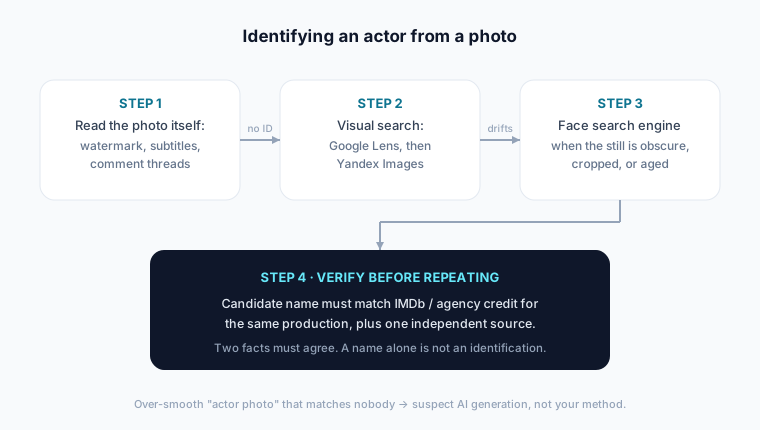
Step 4: verify the name before you repeat it
A candidate name is not an identification until two independent facts agree. The minimum standard: the name appears on the performer's official IMDb or agency page in a production matching the photo's context, and at least one second source — a press interview, the production's official social account, a credit list — connects them to the same project or look.
Watch for the classic traps. Same-show confusion: supporting actors get credited to leads constantly, and the credited name that surfaces most often in comments is not always the face you are looking at. Genuine look-alikes compound the problem — our doppelganger finder guide explains why near-matches are so common. Sibling and relative look-alikes: several well-known performers have relatives in the industry, and photos get swapped. Name collisions: two actors sharing a name is common enough that IMDb disambiguates with roman numerals — link the wrong one and your 'source' disproves itself.
If you plan to post the identification anywhere, do one last thing: search the name together with the production. If the pairing has never appeared anywhere before you, the burden of proof is on you, not on the internet to confirm.
What actually works, in one line each
The whole sequence, compressed:
- Streaming screenshot → check watermark and comment threads first.
- Well-known still → Google Lens resolves it immediately.
- Obscure or cropped face → Google Lens plus Yandex, then a face search engine.
- Candidate name → verify against IMDb and one independent source before repeating it.
- Over-smooth 'actor photo' that matches nobody → suspect AI generation, not your searching.
Put it into practice
Run your first face search in minutes
Upload a photo to find matching profiles across the web
Reverse Face SearchRelated Tools & Guides
Quick FAQ
Is there an app that tells you what actor is in a photo?
There is no app dedicated solely to actor identification. General visual search (Google Lens) plus face search engines covers the same ground. Apps marketed as 'celebrity face finders' are typically wrappers around these same engines.
Why does Google Lens give me the wrong actor?
Lens matches visual similarity, not identity. Similar hairstyles, era-specific makeup, and fan edits of look-alikes all rank highly. If the results show several different names, the search is inconclusive — escalate to a face search engine and verify against IMDb.
Can I identify an actor from a movie screenshot?
Yes, and it is the easiest case. Crop to the face, run Lens, and cross-check the credited cast of the production. If the film is obscure, note the watermark and subtitle language — regional production databases are often indexed by those details.
The photo might be AI-generated. Can I still identify the person?
If the face is synthetic, there is no actor to find. Signs include over-smooth skin texture, inconsistent jewelry or teeth across frames, and a source account that posts casting offers. Reverse image search typically returns no consistent origin for such images.
Is it okay to identify a private person the same way?
Identifying public performers in their professional work is uncontroversial. Applying the same techniques to private individuals raises privacy and safety issues, and results are far less reliable because private people have small image footprints. Do not publish identifications of private individuals.