How to Tell if a Photo Is a Deepfake: Signs, Tools, and Limits
A practical 2026 guide to deepfake and AI-photo detection: the visual signs that still work, why human eyes fail on modern generations, how to combine reverse image search with an AI face detector, and what detectors honestly cannot do.
In This Article
Why deepfake photos got hard to spot
Two years ago, the common advice was to look for warped backgrounds, impossible shadows, or the uncanny-valley skin texture, and it worked often enough to be useful. Generation quality moved. Current diffusion-based models render coherent hands, plausible hair edges, natural lighting falloff, and realistic glasses reflections as a matter of course. The tells that circulated widely have been optimized away precisely because they were widely known.
What has not changed is the structure of the problem. A fake photo usually has to survive two different tests: does it look right on its own, and does the person in it exist in the world? The first test is a losing battle for human eyes on high-quality generations. The second test is where most fakes still fail, because an invented face has no history — no other photos, no tagged appearances, no years of context. The workflow below is built around that asymmetry.
This guide focuses on still images. Video deepfakes add voice and motion analysis on top of the same principles, and the final section notes where those checks differ. Nothing here should be used to accuse a specific person of being fake based on one signal; the limits section explains why.
The visual signs that still catch some fakes
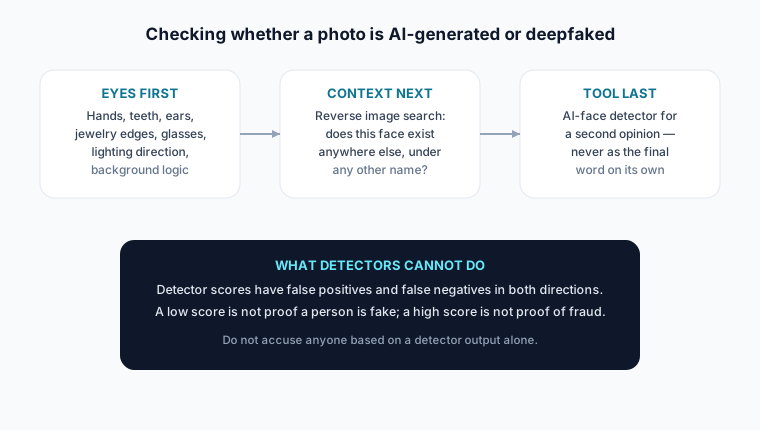
Automated generation is uneven across a photo. The face gets most of the model's attention; peripheral details often lag. Before reaching for any tool, zoom to 100% and spend two minutes on the areas where artifacts still cluster.
Hands are the classic check and remain productive: count fingers, look at fingernails, and check whether a hand holding an object actually deforms it. Teeth are second — older generations produced fused or numbered-looking rows, and even recent ones blur individual teeth at the gumline. Ear asymmetry between the left and right ear in the same photo is another persistent weakness, along with earrings that intersect the earlobe incorrectly.
Then check physics rather than pixels: does the lighting direction on the face match the shadows on the background and the reflections in the eyes? Does the collar sit on the shoulders or float near them? Does the background depth make sense with the claimed camera distance? A single artifact proves nothing — compression and old cameras create real weirdness — but two or three independent physics failures in one image shift the odds heavily toward synthetic.
- Hands: finger count, nail rendering, object interaction.
- Teeth and ear symmetry at high zoom.
- Lighting direction consistency across face, shadows, and eye reflections.
- Edge fusion where hair, glasses, or collars meet the face.
- Background text: generated signage is often letter-shaped but unreadable.
Where human eyes fail — and context wins
The uncomfortable research finding of the last two years is that untrained viewers now score barely better than chance on high-quality synthetic faces, and brief training wears off quickly. The artifacts section above raises your hit rate; it does not make you reliable against a deliberately produced image. Treating your own eyes as a screening step rather than a verdict is the correct mental model.
Context checks exploit the fake's biggest weakness: an invented person has no past. Run the photo through reverse image search — if the face was lifted from a stock model, an influencer, or a stolen gallery, the original usually surfaces within minutes. If visual search comes back quiet, face search answers the deeper question: does this same face appear anywhere else, attached to any other name or account?
A real person accumulates a photo trail over years — different cameras, angles, ages, contexts. A synthetic face typically appears abruptly, in polished photos only, sometimes on multiple profiles with mismatched details. Absence of history is not proof of fakery; some genuine people are barely online. But polish-plus-absence, combined with any other red flag in the situation (a request for money, an inconsistent story, a too-good listing), is the pattern that matters.
AI detection tools: what the score actually means
Detection tools classify an image based on statistical traces left by generation pipelines — frequency-domain artifacts, noise patterns, and texture regularities that differ from camera-captured images. A purpose-built AI face detector gives you this second opinion in seconds, and it catches things eyes miss on both sides: images that look perfectly natural but are synthetic, and unusual-but-real photographs that only look suspicious.
Read every score as a probability, never as a verdict. Detectors publish strong benchmark numbers, but benchmarks differ from live conditions: compression, screenshots, re-cropping, and social-media re-encoding all degrade the traces detectors rely on, which produces false negatives. Conversely, heavily edited genuine photos, professional studio lighting, and some camera processing can trigger false positives. Both error types are documented across every published detector.
This is why the workflow runs eyes, then context, then tool. A detector score only means something anchored to the other two layers: a synthetic-looking score plus zero photo history plus physics artifacts in the image is a strong synthetic indication. The same score on a decades-old scanned family photo should send you back to question the tool, not the family.
Limits, responsibility, and when the answer is still unknown
Some questions cannot be settled from the image alone. Heavily compressed images lose detector signals. Real people can have almost no online footprint. The newest generation models keep closing the artifact gap, and provenance standards like C2PA content credentials exist but are attached to only a small fraction of images actually circulating. If the stakes are high — identity verification, a legal dispute, a public accusation — a single photo check is not sufficient evidence, and a forensic analysis by a qualified expert is the appropriate next step.
Responsibility cuts both ways. Detecting a fake profile protects you and the people whose photos were stolen. Announcing that a specific private person's photo is AI-generated, based on a detector score or a hunch, can itself cause real harm when the judgment is wrong. Keep the conclusion proportionate to the evidence, keep private individuals out of public call-outs, and report synthetic profiles to the platform instead of the crowd.
The practical habit worth building: for any photo that matters to a decision — a date, a seller, a job applicant, an investment pitch — run the three-layer check and require the layers to agree before acting. Most fakes still fail the context layer within minutes. The ones that pass all three layers are rare, and genuinely uncertain cases deserve the word uncertain.
Put it into practice
Run your first face search in minutes
Check if an image is AI-generated or real
AI Face DetectorRelated Tools & Guides
Quick FAQ
What is the most reliable way to tell if a photo is a deepfake?
No single method is reliable on its own. The strongest practical approach combines three layers: visual artifact screening, a reverse image and face search for the person's photo history, and an AI detection tool score. When all three point the same way, confidence is high; when they disagree, treat the result as inconclusive.
Can Google detect deepfake photos for me?
Google Lens finds visually similar images, which surfaces stolen or recycled photos but is not designed to classify whether a face is synthetic. Detection requires a dedicated tool plus the context checks described above.
Do deepfake detectors work on photos from social media?
With reduced reliability. Compression and re-encoding on social platforms erase many statistical traces detectors depend on, which increases false negatives. Run the original file when you have it, and weight the context layers more heavily.
Is it illegal to create a deepfake photo?
Laws vary by jurisdiction and use. Many countries criminalize non-consensual deepfake imagery, impersonation, and fraud; synthetic photos for declared art or satire are treated differently. Using a detector to protect yourself is legal essentially everywhere; publishing accusations about a real person based on an unverified score carries legal and ethical risk.
Why did the old visual signs stop working?
Generation models are trained partly on feedback that fixes visible artifacts. Once a tell like warped hands became widely known, outputs improved specifically in those areas. Physics and context checks degrade more slowly than pixel-level tells, which is why the workflow front-loads them.