Marketplace Seller Photo Check: Verify a Seller Before You Pay
A three-step photo verification workflow for Facebook Marketplace, Craigslist, and any peer-to-peer seller: reverse image search, face search, and profile consistency checks that catch the most common reseller and fake-profile scams before payment.
In This Article
Why the seller photo is the first thing to check
Peer-to-peer marketplace fraud follows a pattern that has stayed remarkably stable while the platforms around it changed. The scammer needs to look trustworthy fast, and the cheapest way to do that is a photo that belongs to someone else: a stock model, a scraped influencer shot, or a real person's profile picture lifted from an unprotected account. The item listing itself is often real — a genuine product photo pulled from a store — which is why checking the listing photo proves nothing about the seller.
The seasonal shape matters too. Seller-fraud reports cluster in the weeks before major gift-giving holidays, when deal pressure is high and buyers are hurrying. The check below takes about fifteen minutes, costs nothing for the first layer, and catches the majority of the borrowed-photo pattern before any money moves.
One framing note: the goal is not to prove a seller is a scammer from their face. People are not owed suspicion because of how they look in a selfie. The goal is to verify that the photo, the profile, and the deal are mutually consistent — and to walk away when they are not.
Step 1: reverse image search the profile photo
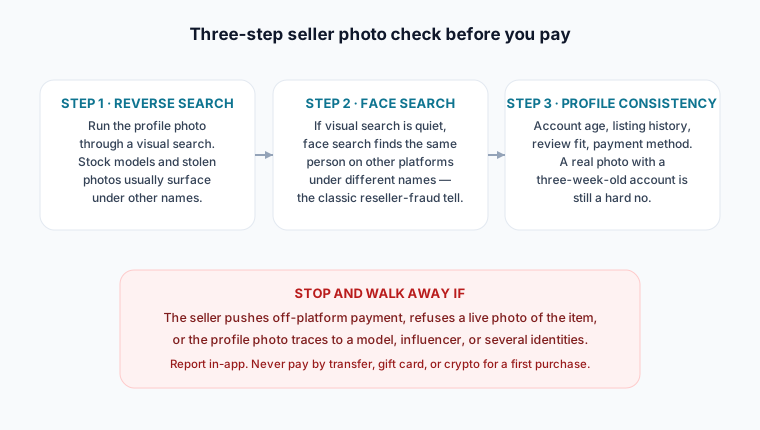
Save or screenshot the seller's profile photo and run it through reverse image search. This layer catches the laziest and still most common version of the scam: a photo lifted directly from a stock library, a modeling portfolio, or another person's public profile. Lens or a similar tool usually surfaces the original in minutes, often under a completely different name or on a completely different continent.
Interpret the results with a little nuance. A photo that appears nowhere else is not proof of honesty. A photo that belongs to a stock model is close to proof of dishonesty. A photo that belongs to a real private person who has nothing to do with the listing is proof of theft — and also a warning that the real person's identity is being used, which is worth reporting to them if the original account is identifiable.
Photos that were stolen and then slightly edited — cropped, mirrored, filtered — defeat naive visual search. That is what the next layer is for.
Step 2: face search when visual search comes back empty
Face search compares the face itself rather than the exact pixels, so a cropped, filtered, or re-uploaded photo still matches the person's other appearances. Running the photo through a face search engine answers the question that matters most in reseller fraud: does this same person exist online under other names, selling other things?
The classic multi-identity pattern looks like this: the same face attached to a fitness persona on one platform, a pet-sale profile on another, and a marketplace account with a different first name on a third. One genuine person can legitimately have several accounts — but one face presenting several different commercial identities in several niches is the signature of photo-based seller fraud, not of a busy person.
If the face search returns nothing at all, that is a neutral signal, not a clean bill of health. Combine it with the profile-consistency checks in the next step before deciding anything.
Step 3: profile consistency — the check people skip
A stolen photo can survive steps one and two if the thief generated a fresh face. The profile itself is where a fresh facade usually cracks. Check the account age against what is being sold: an account three weeks old claiming a garage full of collectible instruments is a different risk than the same account selling a used phone. Look at listing history for coherence — a real seller accumulates varied listings over months, while fraud accounts post clusters of high-demand items at below-market prices in bursts.
Cross-check the small details that are hard to fake in bulk: does the reviews or feedback reference items actually in the listing history, do the profile photo and any secondary photos depict a consistent person and setting, is the location plausible with the meeting or shipping story. A photo can be real and the profile still fails this test — which is exactly why photo checks alone are never the finish line.
- Account age versus the value and volume of listings.
- Listing history coherence and price realism.
- Review fit: do reviewers mention the same items being sold now?
- Person consistency across profile, listing, and message photos.
- Story consistency: location, availability, and delivery claims line up.
Payment discipline: the layer that works even when photos pass
Every marketplace platform pushes in-app payment for a reason, and the most reliable scam marker has never changed: pressure to leave the platform. Wire transfers, gift cards, cryptocurrency, and peer-to-peer payment apps offered by a stranger for a first transaction remove every protection the platform provides, including dispute resolution and the seller's own accountability.
The second reliable marker is resistance to verification that costs the scammer nothing: a live photo of the item with a handwritten note of your choice, a video call walking through the item, or a public meeting place. A genuine seller with the item in hand can do these in two minutes. A scammer with a folder of stolen photos cannot, and the excuse will arrive before you finish asking.
Keep the whole check proportionate. A fifteen-minute verification for a four-hundred-dollar purchase is sensible; the same ritual for a twenty-dollar item is overkill, and meeting in a public place with in-app payment covers the realistic risk. Scale the check to the money and the meeting, and remember that walking away costs nothing.
Put it into practice
Run your first face search in minutes
Upload a photo to find matching profiles across the web
Reverse Face SearchRelated Tools & Guides
Reverse Face Search
Upload a photo to find matching profiles across the web
Catfish Picture Checker
Verify if someone is using stolen photos
Username Search
Find profiles across 400+ platforms
How to Reverse Image Search
Google Lens, iPhone, Android, Bing, TinEye — and when face search works better
Scammer Photo Lookup
Check photos against known scammer databases
Quick FAQ
How can I tell if a marketplace seller photo is stolen?
Run it through reverse image search first — direct lifts from stock libraries or other profiles usually surface immediately. If that is inconclusive, face search finds the same face under other names across platforms, which exposes the multi-identity reseller pattern.
The seller passed a photo check but wants payment by wire transfer. Is that safe?
No. Off-platform payment for a first transaction with a stranger removes all platform protections regardless of how the photo checked out. Payment method pressure is itself one of the most reliable scam markers.
Can a scammer use a real photo of a real person?
Yes, and it is common — photos are scraped from public accounts. If face search finds the photo belongs to an unrelated real person, the profile is using a stolen identity. Report it to the platform, and if the impersonated person is identifiable, alerting them protects them too.
Is checking a seller photo an invasion of privacy?
Verifying that a commercial counterparty is who they present as, using publicly indexed images, is a standard and legitimate due-diligence step for transactions you initiate. The boundary is publishing accusations or private details; keep conclusions to yourself and the platform's report system.
What if the photo search finds nothing at all?
A photo with no online history is neutral — some genuine people are barely online. Let the profile consistency and payment discipline layers decide the transaction in that case.